No. 1 · Friday, November 13, 2026 · 5-minute read
In this edition
- Chatbots showed shoppers a fake or dead shopping site in 9% of answers in a September test, with Black Friday two weeks away.
- Yahoo’s AI answers will pay publishers through a new collective, which says it pays by how much each page shapes an answer.
- Three in ten shoppers who use AI say it often shows them new brands, so what chatbots say about you matters.
- Plus: Google’s new AI model, more ads in AI Mode, a rank-tracker warning, AI sales your analytics miss, ChatGPT in court, the dates.
The big one
Chatbots name fake or dead shopping sites in 9% of answers
In a test of 151 brands, when a chatbot showed a risky site, it warned the shopper away only about one time in ten.

If customers ask a chatbot where to buy your products, the answer may name a website that isn’t yours.
Podqi, a firm that takes down fake shops for brands, tested ChatGPT, Google’s Gemini and the AI search app Perplexity in September. It asked them five where-to-buy questions about each of 151 brands, repeating each question on three days.
Of the 6,795 answers, 9% showed the shopper a risky site: a fake or knockoff shop, or a dead web address that anyone could buy. Podqi shared the study with The Verge, which reported it on Thursday.
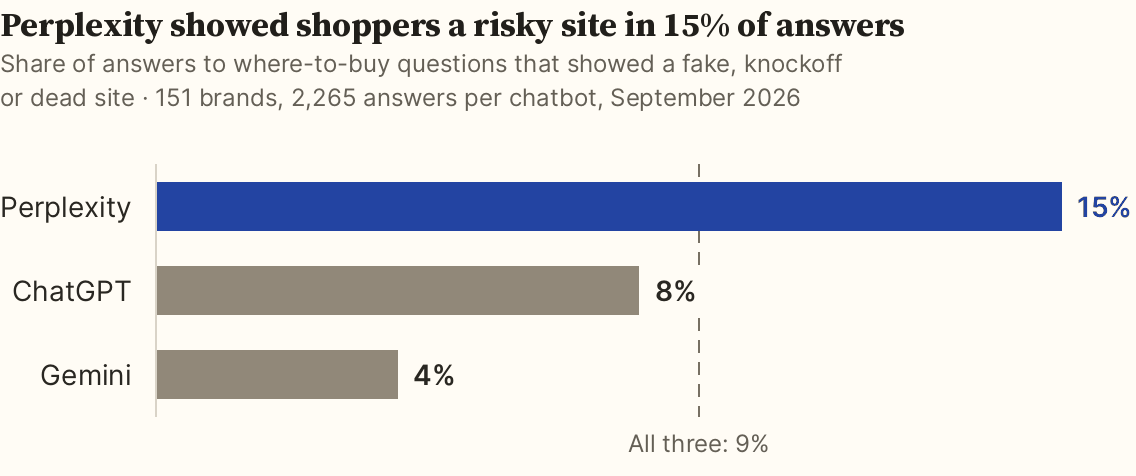
Perplexity did worst, showing a risky site in 15% of its answers, ChatGPT in 8% and Gemini, best of the three, in 4%. When an answer showed a risky site, it usually recommended that site as a place to shop. Only about one in ten warned the shopper away.
The riskiest question sounded the most innocent: does this brand ship abroad, and what are its websites in other countries? Of those answers, 16% showed a risky site.
Smaller brands, those under $500 million in yearly sales, fared worse. Answers about them showed risky sites twice as often as answers about bigger brands, the study’s full report says.
Podqi also tested Google’s AI Overviews, the AI answers at the top of Google’s results. It scored them separately, because they gave no answer to one question in seven. Of the answers they did give, just 0.4% showed a risky site, and each of those warned the shopper.
Why it matters: two weeks before Black Friday, a wrong answer can cost you the sale and the shopper money. Your own analytics won’t show it, so the simplest way to know is to ask the chatbots yourself.
The study is Podqi’s own, on questions it wrote. Podqi sells takedowns of fake shops, and two of the brands it tested are its customers.
Your move
- Ask ChatGPT, Gemini and Perplexity where to buy your products, whether you ship abroad and what your websites in other countries are. Note every address they give that isn’t yours or an authorized retailer’s, and check each one.
- Put your official shops and authorized retailers on one page, country by country, and link it from your site’s footer, as Podqi advises.
- Check whether any web address you once used has lapsed. Anyone can buy it, and a chatbot may still send shoppers there.
Sources: Podqi · The Verge · Podqi report

Also big
Yahoo’s AI answers will pay publishers through a new collective
If AI answers draw on your pages, a new group of publishers wants to get you paid for it, however small your site.
On Thursday, more than 3,000 media brands and publishing platforms launched the Internet Licensing Collective. The nonprofit sells AI companies one license to the content its members opt in. Yahoo’s AI answer engine, Scout, signed first. The collective says it pays members by how much their work shapes an answer, and they can still sign deals of their own.
Why it matters: it’s a live test of whether AI answers will pay for the pages they draw on. So far Yahoo is the only buyer, and neither side gave a price.
Your move
- Joining is free. It takes an account and a file on your site that says which pages AI companies may license.
Sources: Internet Licensing Collective · ILC for publishers
The number
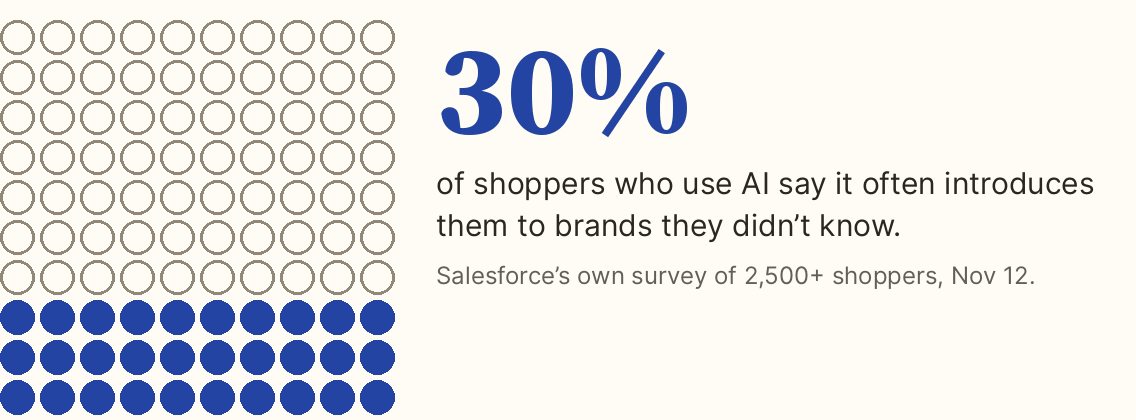
Three in ten shoppers who use AI say it often introduces them to brands they didn’t know. Almost one in five shoppers say AI is now their first stop. That’s from Salesforce’s own survey of more than 2,500 people in four countries. So a chatbot’s answer can win you customers, or send them elsewhere.
Quick hits
- Google’s new AI model. Gemini 4 Hydrogen, Google’s newest AI model, is now the default in AI Mode, Google’s chat-style search. It also answers “your hardest questions” in AI Overviews, Google Search vice president Robby Stein posted. So if Google’s AI answers began citing different sites on Thursday, don’t blame only the core update. That’s the broad re-ranking of results Google began on Nov. 10.
- More ads in AI Mode. An AI Mode answer about golf shoes ended with a “Sponsored” block of products “available from local retailers,” SEO consultant Glenn Gabe posted. Clicking one of the answer’s sources opened a panel with more ads. Google’s help pages say it is testing local inventory ads, for products in stock at nearby stores, in its AI answers. The golf-shoe ads are Gabe’s sighting; we found no comment from Google.
- Rank-tracker drops. If your rank tracker shows a drop during this week’s core update, check Search Console, Google’s own report on your traffic, before you act. Rank trackers check where your pages rank with automated searches. Google answers some of those with altered pages, say two firms that collect its results. Moz, which makes a tracker, says every tracker has been hit to some degree since late September. SerpApi, which sells Google results to other tools, warns a tracker “might report a drop that never happened.” Google hasn’t commented. SerpApi is fighting a Google lawsuit over how it collects Google’s results.
- Claude’s new rule. A new rule for Claude, Anthropic’s AI assistant, took effect on Thursday. It bars using Claude to build networks of sites that pose as independent sources to sway search engines and AI answers. If you pay an agency to get your brand into AI answers, ask whether it builds such sites.
- AI’s hidden sales. A sale that starts in an AI answer often shows up in your analytics as a search visit, or as someone typing in your address. That’s the warning in a new guide from the Interactive Advertising Bureau, the digital ad industry’s trade group. So if visits from AI tools look flat in your reports, AI may still be bringing you more than they show.
- Search without AI. Google said on Nov. 3 that Search and its Gemini tools will be off for K-12 students’ accounts until each school turns them on. New York City’s council says that plan suggests schools may not be able to switch off AI Mode and AI Overviews without losing Search. On Thursday it asked Google whether they can, and wants an answer by Nov. 19.
In court
- ChatGPT and the news. News publishers including The New York Times say ChatGPT broke their copyright by copying their articles to answer questions. On Thursday, Judge Sidney Stein let them ask for a ruling on that without a trial, though they had missed a deadline. Their motion is due Nov. 25.
On the record
“the best starting point for guaranteed authentic items”
Perplexity, in Podqi’s test, about a page it wrongly called Stüssy’s official site, The Verge reports
What to watch
- Nov 24 By now, Google’s core update, the broad re-ranking it began Nov 10, should be finished
- Nov 27 Black Friday
- Nov 30 Google’s deadline to refile its suit against SerpApi, after a judge dismissed it on Nov 9
- Dec 1 Ahrefs switches to a new Domain Rating, the SEO tool’s score for the links pointing to a site
- Dec 3 In the UK, Google must let publishers keep their content out of AI Overviews and AI Mode without a penalty in Search
- Dec 15 Bing Webmaster Tools, Bing’s dashboard for site owners, opens a temporary AI setting for sites that use Bing’s older NoArchive or NoCache tags
How this edition was made
Every fact links to where it came from, and a note marks anything short of confirmed. We read 38 items from the past day. The company or court involved confirmed 24 of them, and 2 came from press reports. Seven were a company’s own figures that no one else had checked, and 5 were sightings no company had confirmed. Ten of the 38 run here.
Corrections: In our sample issue, No. 0, we said a Bing tool for its new AI controls opens on Dec. 15. What opens that day is a temporary setting in Bing Webmaster Tools, and only for sites that use Bing’s older NoArchive or NoCache tags. Bing starts honoring the new controls on Feb. 1, 2027.
The illustration and the meme are made with AI. The chart and the number are drawn from the published figures they name.
Sources
- Podqi, “AI search is recommending fake retail websites”, study with data from Gauge, November 12, 2026
- Mia Sato, “AI chatbots are recommending fake retail websites, study finds”, The Verge, November 12, 2026
- Podqi, AI Search Brand Risk Report 2026 (PDF), appendix: data and method
- Salesforce, “New Data: Holiday Shoppers Will Rely on Agents. Retailers Must Be Ready.”, November 12, 2026
- Internet Licensing Collective, “The Internet Licensing Collective (ILC) Launches with Yahoo Scout as First Commercial Partner”, November 12, 2026
- Internet Licensing Collective, page for publishers
- Hilman Ramadhan, SerpApi blog, on poisoned Google search results, November 12, 2026
- Moz Help Hub, “Scrambled SERP Issues”, October 21, 2026
- Robby Stein, VP of Product, Google Search, post on X, November 12, 2026
- Anthropic, Usage Policy, effective November 12, 2026
- Glenn Gabe, post on X with screenshots of AI Mode, November 12, 2026
- Google Ads Help, “About ads in AI-powered experiences in Google Search”
- IAB, “The AI-Era Attribution Blueprint”, November 12, 2026
- U.S. District Court, S.D.N.Y., In re OpenAI Copyright Infringement Litigation, order of November 12, 2026
- New York City Council, letter to Sundar Pichai, November 12, 2026
- Google Search Status Dashboard, “November 2026 core update”, November 10, 2026
- U.S. District Court, N.D. Cal., Google v. SerpApi, order of November 9, 2026
- Glen Allsopp, “Introducing a Preview of DR4”, Ahrefs, November 5, 2026
- UK Competition and Markets Authority, Google Search publisher conduct requirement
- Krishna Madhavan, “Your content, your choice: clearer preferences for training and grounding”, Bing Search Blog, October 30, 2026
- Chris Phillips, “Designing responsible AI for learning”, The Keyword, November 3, 2026